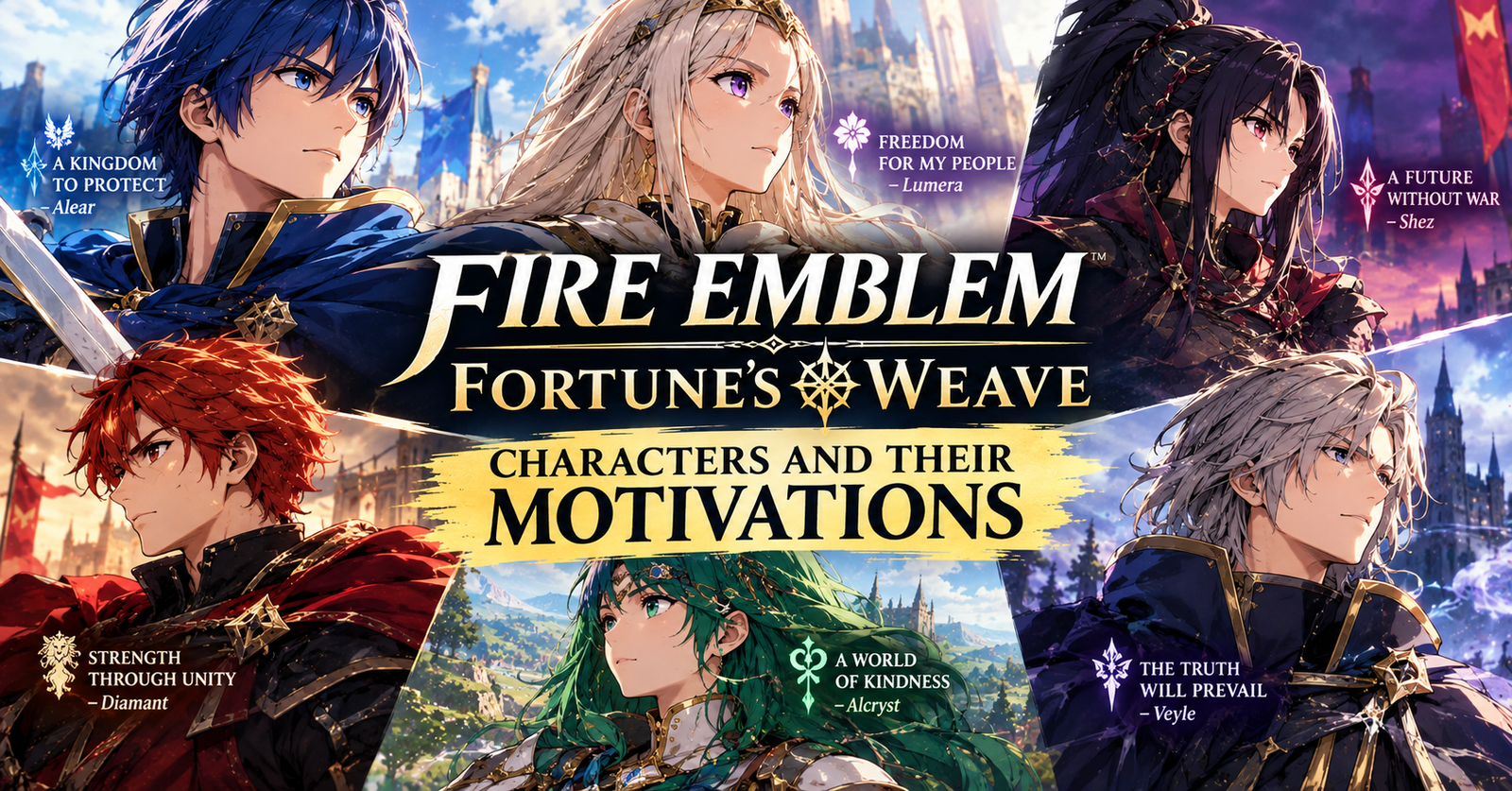
What would you risk if winning a tournament could grant your greatest wish, yet the fate of the world depended on what happened next? Fire Emblem: Fortune’s Weave brings that question into a tactical role-playing adventure filled with rival ambitions, powerful warriors, and a threat that reaches across time.
Released on September 17, 2026, exclusively for Nintendo Switch 2, the game introduces a new setting and four central heroes whose stories connect to a much larger conflict. This guide explores its unusual premise, main characters, tactical battles, time-travel story, and expansion content, helping you understand what makes this entry different from previous Fire Emblem games.
What Is Fire Emblem Fortune’s Weave About?
Fire Emblem: Fortune’s Weave takes place in the Dagdan Empire, a prosperous land shaped by the influence of gods. Its capital, Dagsion, hosts the Heroic Games, a competition that attracts powerful fighters from across the region. The winner receives a single wish, giving each participant a personal reason to fight.
At first, the tournament appears to be a contest of strength and ambition. However, the larger story reaches beyond the arena. A resurrected demon god named Balor threatens the world, and the struggle to stop him connects the heroes’ personal goals to a much greater disaster.
The story uses time travel to connect events across different periods. With help from Fortuna, a goddess who can travel through time, the player works to guide heroes from the past toward a future where the world can still be saved. This structure gives the game a different focus from a straightforward tournament story.
Rather than following one hero’s journey alone, the narrative weaves several perspectives together. As a result, personal motivations and larger events become closely connected, giving players reasons to understand what drives each character.
Fire Emblem Fortune’s Weave Characters and Their Motivations
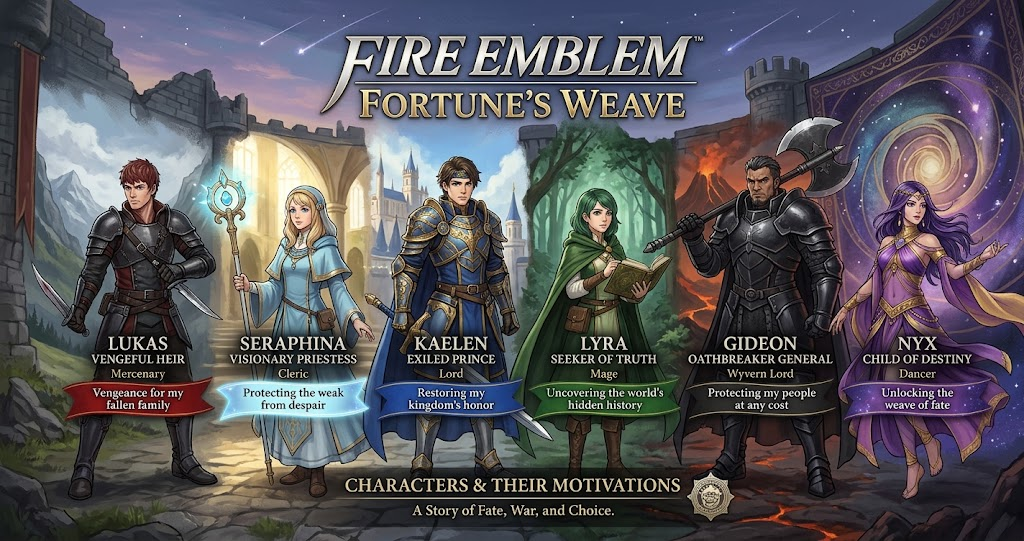
The four central heroes give the story much of its personality. Each enters the Heroic Games with a different goal, so their decisions are shaped by more than a simple desire to win.
Cai: A Son Fighting for His Father
Cai is a young boy determined to win the Heroic Games to save his imprisoned father. His motivation gives his journey a personal foundation, making the competition about family as much as victory.
His story may appeal to players who enjoy protagonists facing difficult choices. Cai’s goal is clear, but the wider conflict places his personal hopes within a situation far bigger than one family.
Dietrich: A Warrior Seeking a Challenge
Dietrich is a swordsman who constantly searches for a stronger opponent. Unlike Cai, his ambition centers on combat and the pursuit of strength. This makes him a natural fit for a story built around powerful fighters competing against one another.
His perspective also raises an interesting question: what happens when the desire to find a worthy rival meets a threat that endangers everyone?
Theodora and Leda: Ambition and Revenge
Theodora is a queen seeking to fulfill a long-held dream for her homeland. Her motivation connects individual success to the future of an entire people. Consequently, her choices carry political and personal importance.
Leda, meanwhile, is a musician driven by revenge. Her goal gives the story a more emotional edge, because vengeance can shape a character’s decisions in ways that simple ambition cannot. Together, the four heroes create a range of motivations that help distinguish their paths.
How Tactical Combat Shapes the Adventure
Strategy remains central to the Fire Emblem experience. Instead of relying only on quick reactions, players must consider unit positioning, movement, enemy threats, and the timing of their decisions.
Every battle presents a problem to solve. Moving a unit into range might create an opportunity to attack, but it can also leave that character exposed to an enemy’s response. Therefore, understanding the battlefield matters just as much as choosing a powerful attack.
The game also allows players to rethink their strategy when a plan goes wrong or a favored unit is routed unexpectedly. This gives experimentation a meaningful place in combat. Rather than treating every mistake as the end of a plan, players can reconsider their approach and learn from the outcome.
For newcomers, the best habit is to examine the battlefield before committing to movement. Consider which enemies can reach a unit, whether an ally can provide support, and how the next turn might unfold. These small decisions can make a major difference during difficult encounters.
What Makes the Time-Travel Story Different?
Time travel is more than a background detail in Fortune’s Weave. It provides the framework for connecting the heroes’ journeys to the world’s eventual crisis.
The story begins with the threat of Balor and the possibility that the Dagdan Empire will fall. Fortuna offers a way to change the outcome by guiding heroes from the past toward the future. This setup creates a clear reason for the player to bring different characters and events together.
The concept also adds tension to the narrative. The heroes have their own ambitions, yet their choices can influence events far beyond their original goals. A personal struggle may become part of a much larger effort to prevent disaster.
Players who enjoy fantasy stories about destiny, sacrifice, and consequences may find this structure especially appealing. At the same time, the separate character paths give the story room to explore different perspectives rather than presenting the conflict from only one point of view.
Fire Emblem Fortune’s Weave Features at a Glance
The table below summarizes the major elements that define the game and the role each plays in the experience.
| Feature | Description | Why It Matters |
|---|---|---|
| Heroic Games | Tournament held in Dagsion | Connects the heroes’ ambitions |
| Four central heroes | Cai, Dietrich, Theodora, and Leda | Provides different story perspectives |
| Time travel | Connects the past and future | Drives the central conflict |
| Tactical battles | Strategy-focused combat | Rewards planning and positioning |
| Dagdan Empire | Main setting of the story | Establishes the political and divine backdrop |
| Nintendo Switch 2 | Exclusive platform | Determines where the game can be played |
Together, these elements give Fortune’s Weave a distinct identity. The tournament provides the starting point, while the time-travel plot expands the stakes and tactical battles turn the story’s conflicts into player decisions.
Fire Emblem: Fortune’s Weave Release Date and Platform
Fire Emblem: Fortune’s Weave launched on September 17, 2026, for Nintendo Switch 2. Nintendo lists the game as a single-player role-playing and strategy title, with TV, tabletop, and handheld play modes supported.
That platform focus matters when deciding whether to buy it. The game is designed for Nintendo Switch 2, so players using the original Nintendo Switch should not assume it runs as a native game on their console. Check the official Nintendo listing for current compatibility and purchase details before buying.
The game is also available in physical and digital formats, depending on the region and retailer. Edition contents and regional availability can differ, so compare the store listings before choosing a version.
For the most reliable information, consult the official Nintendo game page and its developer interviews. These sources provide details about the setting, characters, gameplay systems, and design decisions directly from the publisher and development team.
What Does the Fortune’s Weave Expansion Pass Include?
The Expansion Pass adds content beyond the main game through three planned waves. Nintendo’s official support information says the first wave includes prototype weapons for the four heroes, inspired by Heroes’ Relics from Fire Emblem: Three Houses.
The second wave is planned to add the aid of three powerful gods, Aurora, Smyrnos, and Jurah, alongside new wearable outfits. The third wave is scheduled for 2027 and is set to introduce additional stories involving Bertrand, Talimun, Orchel, and Anatolia, with new allies and classes to unlock.
These additions are aimed at players who want more options after exploring the main adventure. However, it is worth checking the official Expansion Pass listing before purchasing, since release timing and included content can change. The base game is needed to use the additional content.
Who Should Play Fire Emblem Fortune’s Weave?
Fortune’s Weave is a strong option for players who enjoy tactical battles supported by a character-driven fantasy story. The different motivations of the four heroes provide several emotional entry points, while the time-travel premise links their journeys to a shared threat.
Fans of earlier Fire Emblem games may appreciate the strategic focus and the way unit decisions affect the flow of battle. New players can also approach it as a separate adventure, since the story introduces its own world, cast, and central conflict.
Still, the game’s pace may not suit everyone. Players who prefer fast action or open-world exploration may find its tactical structure slower. Its appeal comes from planning moves, learning about characters, and watching separate story threads connect.
Conclusion
Fire Emblem: Fortune’s Weave combines a tournament built around personal wishes with a time-travel story about preventing the world’s destruction. Its four heroes bring different ambitions to the same conflict, while tactical battles give players control over how they face its challenges.
The game launched for Nintendo Switch 2 on September 17, 2026, and its Expansion Pass offers more content for players who want to continue beyond the main adventure. If you enjoy strategic combat and character-driven fantasy, check the official game listing and see whether Fortune’s Weave fits your next gaming session.
FAQs
When did Fire Emblem: Fortune’s Weave release?
Fire Emblem: Fortune’s Weave launched on September 17, 2026. Nintendo released it exclusively for Nintendo Switch 2. Players can check the official Nintendo store or their regional retailer for physical and digital availability, edition details, and current pricing.
Who are the main characters in Fortune’s Weave?
The four central heroes are Cai, Dietrich, Theodora, and Leda. Cai wants to save his imprisoned father, Dietrich seeks stronger opponents, Theodora hopes to fulfill a dream for her homeland, and Leda pursues revenge. Their different motivations connect to the wider story.
Is Fire Emblem: Fortune’s Weave a strategy game?
Yes. Fortune’s Weave is a tactical role-playing game that emphasizes planning, unit positioning, and battlefield decisions. Players need to think about movement and enemy threats instead of relying solely on quick reactions. The story and character paths provide context for the battles.
Is Fortune’s Weave available on the original Nintendo Switch?
No. Nintendo lists Fortune’s Weave as a Nintendo Switch 2 game. Players with the original Nintendo Switch should check the official platform information before purchasing, because the title is not listed as a native release for the older system.
What is included in the Fortune’s Weave Expansion Pass?
The Expansion Pass includes three waves of additional content. The first adds prototype weapons for the four heroes, the second is planned to add three gods and outfits, and the third is scheduled for 2027 with more stories, recruitable allies, and classes. Check Nintendo’s support page for updated release details.
For more updates visit: PUBLIC TALK